
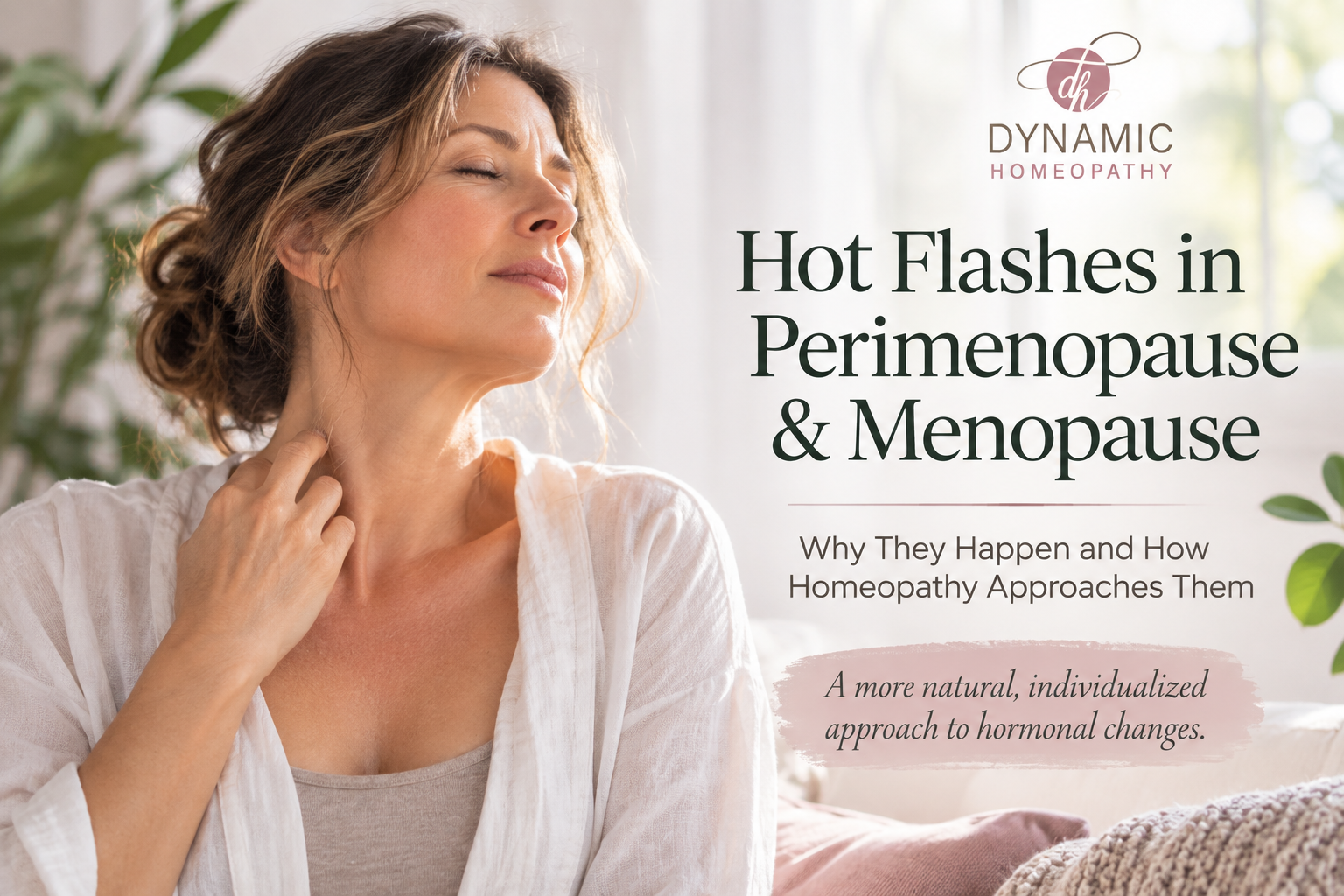
One minute you feel perfectly comfortable. The next, heat seems to rise through your chest, neck or face. You may flush, perspire, throw off the covers or reach for a window — only to feel chilled again a few minutes later.
Hot flashes are one of the symptoms most strongly associated with menopause, but they can begin years before your final period, during perimenopause. For some women they are occasional and relatively mild. For others, they happen repeatedly throughout the day or wake them several times at night.
And although we use one name — hot flashes — women don’t necessarily experience them in the same way. That difference matters in homeopathy.
Why Do Hot Flashes Happen During Perimenopause?
During perimenopause, ovarian hormone production becomes less predictable. Estrogen doesn’t simply decline in a smooth, steady line; levels can fluctuate considerably during the transition.
These hormonal changes can affect the body’s temperature-regulating mechanisms. As a result, relatively small changes in body temperature may trigger a much larger heat-loss response: blood vessels near the skin widen, the skin may become flushed and sweating may begin.
This sudden episode of heat is commonly called a hot flash or hot flush. When the same thing occurs during sleep, it may be experienced as a night sweat — sometimes enough to wake you, require a change of clothing or bedding, or make it difficult to fall asleep again.
That means hot flashes and sleep problems can become closely intertwined during perimenopause.
What Can a Hot Flash Feel Like?
A typical hot flash may involve sudden warmth across the upper body, flushing of the face or neck, perspiration, a racing or noticeable heartbeat, and sometimes anxiety or an unsettled feeling.
But this is where the description “I have hot flashes” stops being enough for me as a homeopath.
I want to know your hot flashes.
Does the heat begin in your chest and rise upward? Does your face become intensely red? Are you drenched in perspiration, or do you feel intensely hot without sweating? Do you become cold or shivery immediately afterward? Are your feet burning while the rest of you feels comfortable?
Do the flashes happen predominantly at night? Do they wake you at a particular time? Are they worse before your period? Did they begin alongside heavier or irregular periods? Do you feel anxious, irritable, restless or overwhelmed when they happen?
Those details begin to tell us something quite different from the diagnosis alone.
Why Homeopathy Doesn’t Treat Every Hot Flash the Same Way
This is an important distinction in individualized homeopathic care.
If five women come to me experiencing menopausal hot flashes, I would not automatically give all five women the same remedy.
One woman may describe intense upward surges of heat with facial flushing and an intolerance of anything tight around her neck. Another may feel overwhelmingly hot in bed, throw off the covers and have burning feet. Another may be exhausted, irritable and emotionally depleted, with hot flashes occurring alongside changing periods and a strong desire to be left alone. Another may have marked night sweats alongside anxiety, restlessness and disrupted sleep.
The symptom is the same in broad terms. The pattern isn’t.
And it is the pattern that helps guide individualized homeopathic prescribing. This is also why homeopathic remedies aren’t chosen by symptoms alone.
Homeopathic Remedies Commonly Considered for Hot Flashes
There are many homeopathic remedies in which heat, flushing or menopausal symptoms may appear. A few well-known examples illustrate why differentiation matters.
Lachesis may come to mind when there are intense hot flashes, flushing and heat, particularly when symptoms are worse around menopause or before menstruation. There may also be marked sensitivity to tight clothing, especially around the neck or waist.
Sepia may be considered when hormonal changes occur alongside exhaustion, irritability, emotional withdrawal or the feeling of being overwhelmed by responsibilities. Menstrual changes and pelvic symptoms may also form part of the picture.
Sulphur has a strong relationship with heat and burning sensations. A woman may feel excessively hot in bed, uncover herself or experience particularly hot or burning feet.
Sanguinaria canadensis is another remedy associated with menopausal flushing and heat, particularly when there is marked redness of the face or accompanying headache patterns.
These aren’t prescriptions based simply on the presence of a hot flash. They are examples of how different qualities and accompanying symptoms can point toward different remedies.
That is also why searching for the “best homeopathic remedy for hot flashes” can only take you so far. The most appropriate remedy depends on the broader symptom picture.
What Else Was Happening When the Hot Flashes Began?
This is one of the most useful questions in a homeopathic consultation.
Hot flashes rarely exist in isolation during perimenopause. Perhaps your periods have become heavier, shorter, longer or less predictable. Maybe you have also begun waking at 2 or 3 a.m. Perhaps you’re experiencing anxiety that appeared during perimenopause, becoming unusually irritable, struggling with brain fog or feeling exhausted despite sleeping.
Sometimes the most distressing part isn’t even the hot flashes. It’s the feeling that several things in your body and emotional wellbeing changed at once.
This is why I don’t want to separate the hot flashes from everything else you’re experiencing. Your sleep, menstrual cycle, energy, emotional state, stress response, temperature patterns and other physical symptoms can all help me understand the larger picture.
Hot Flashes at Night and Sleep
Nighttime hot flashes deserve particular attention because they can create a second problem: chronic sleep disruption.
You may wake because you’re suddenly too hot, uncover yourself, cool down, become cold, pull the covers back on — and then discover that you’re completely awake.
If this happens repeatedly, the effect can extend well beyond the night. Poor sleep can contribute to daytime fatigue, difficulty concentrating, irritability and reduced resilience to stress.
I’ve written separately about why women may keep waking during perimenopause, as well as homeopathic remedies considered when insomnia and night waking are prominent, because sometimes the sleep pattern becomes as important to the case as the heat itself.
Looking at the Whole Perimenopause Picture
One of the things I hear frequently from women during perimenopause is some version of: “I just don’t feel like myself anymore.”
And often, it isn’t because of one symptom. It’s the hot flashes and the poor sleep. The changing periods and the anxiety. The fatigue, irritability, brain fog or reduced ability to cope with stress that previously felt manageable.
Homeopathic treatment gives us the opportunity to look at those experiences together rather than treating each symptom as though it belongs to a completely separate person.
The goal of the consultation is to understand how this transition is expressing itself in you and select a remedy based on that individual picture. You can also explore my broader approach to homeopathic care during perimenopause.
When Should You Speak With Your Doctor?
Although hot flashes are common during the menopausal transition, new or unusual symptoms shouldn’t automatically be attributed to perimenopause.
If you’re unsure whether what you’re experiencing is a hot flash, symptoms are severe or significantly affecting your daily life, or you’re experiencing concerning symptoms such as chest pain, fainting or significant unexplained heart symptoms, seek medical assessment.
It’s also worth discussing your symptoms with your healthcare provider if you are uncertain whether you are entering perimenopause or want to explore the full range of treatment options available to you.
Looking for Individualized Homeopathic Support?
If you’re experiencing hot flashes alongside changes in sleep, periods, energy, mood or emotional wellbeing, we can look at the whole pattern rather than the hot flashes alone.
At Dynamic Homeopathy, I work with women through perimenopause and menopause using individualized homeopathic care. Virtual consultations are available in Alberta and beyond.
Book a complimentary Hormone Harmony Inquiry Call to see whether working together feels right for you.